For more event information, please check the UCLA Comparative Literature department website.
Winter 2026 Seminar:
Structure

The focus of the 2025-2026 Experimental Critical Theory seminar (COM LIT250), taught by Professor Eleanor Kaufman, is “Structure.”
Featured Event
4/14/26 A Talk with Irving Goh: Living on After Failure
In this talk, Irving Goh will present on his latest book, Living On After Failure (Duke UP, 2025). He will share his thoughts on failure as failure, that is, failure without recuperation, failure as all negativity. Such a thinking of failure as a thorough impasse not only resists narratives of progress and ideologies of success and their accompanying notions of grit and resilience. It also registers, at the ontological level, the affective structure of existence. Professor Goh will also discuss the literary texts that inform his work on failure.
Readings are available below:
Upcoming Talks and Required Readings
For more event information, please check the UCLA Comparative Literature department website.
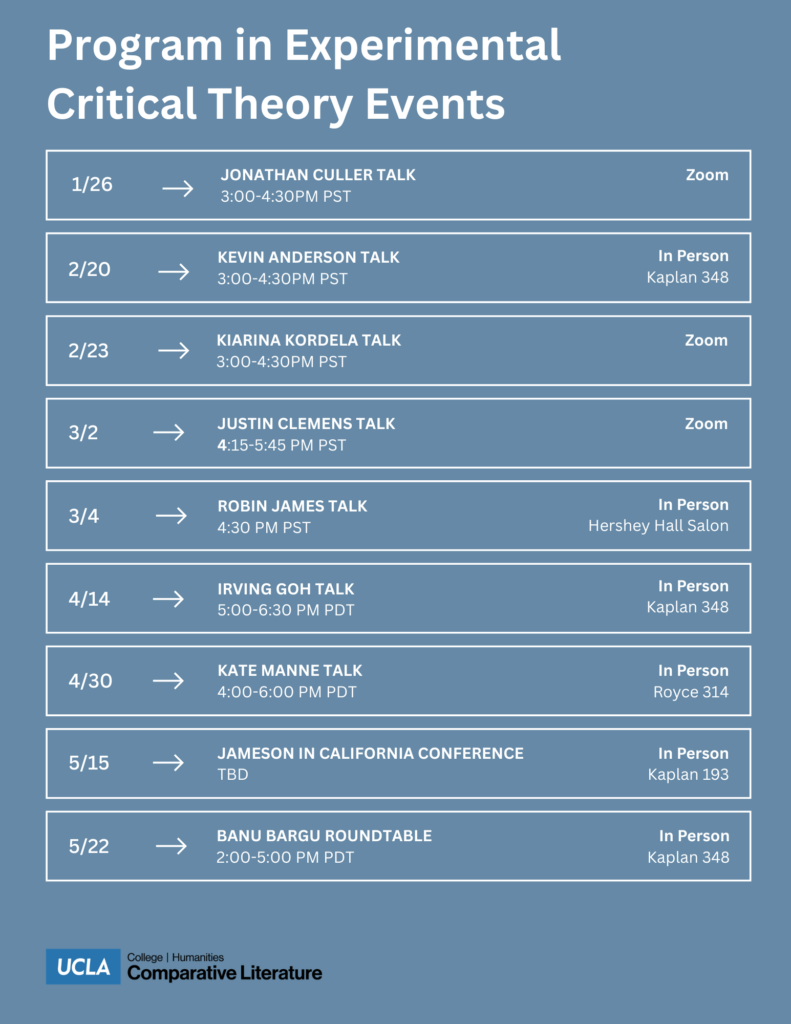
1/26/26 A Talk with Jonathan Culler
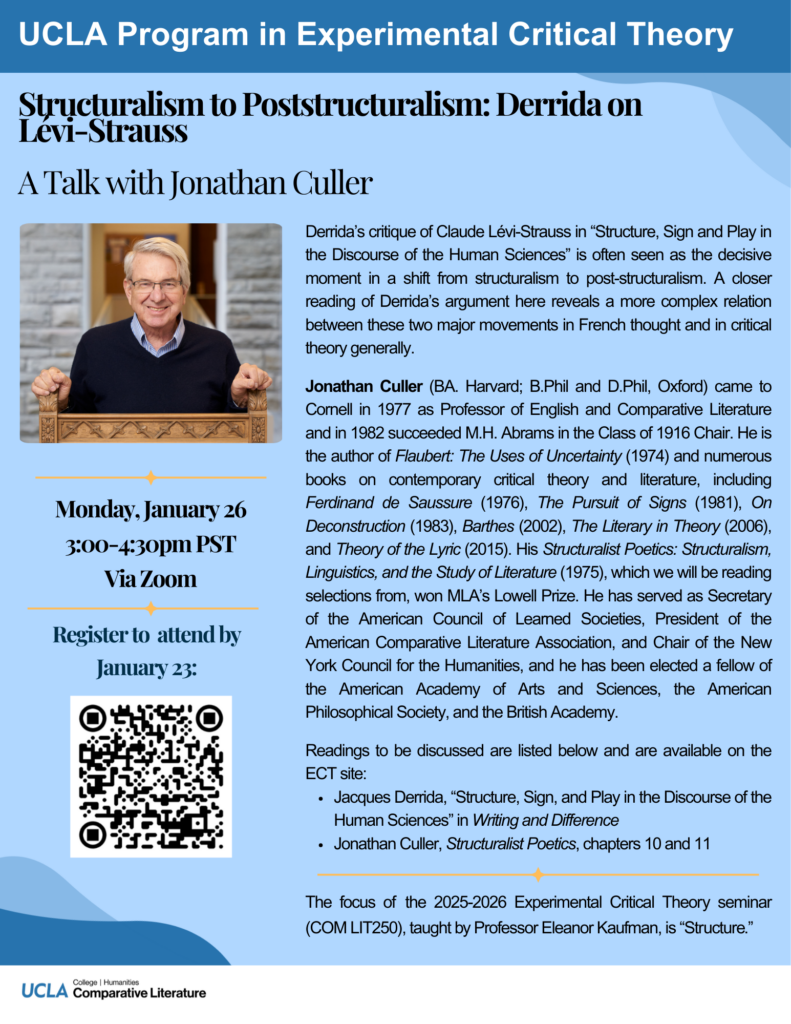
Structuralism to Poststructuralism: Derrida on Lévi-Strauss
Derrida’s critique of Claude Lévi-Strauss in “Structure, Sign and Play in the Discourse of the Human Sciences” is often seen as the decisive moment in a shift from structuralism to post-structuralism. A closer reading of Derrida’s argument here reveals a more complex relation between these two major movements in French thought and in critical theory generally.
Readings to be discussed are linked below:
2/23/26 A Talk with A. Kiarina Kordela
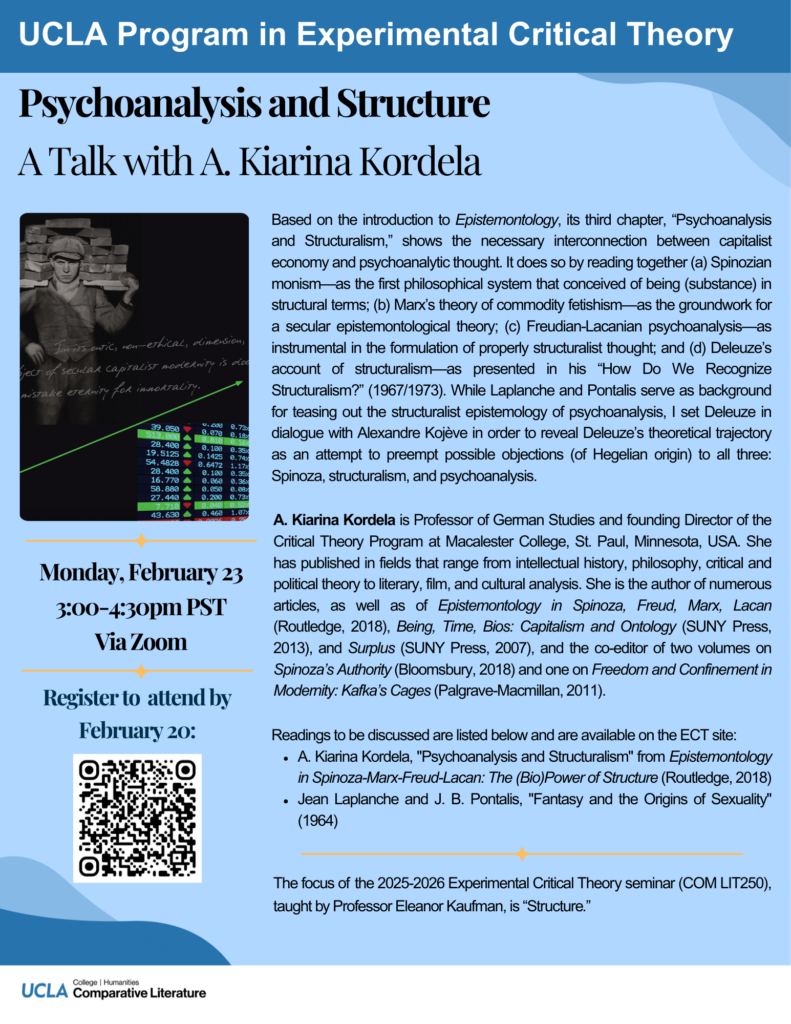
Based on the introduction to Epistemontology, its third chapter, “Psychoanalysis and Structuralism,” shows the necessary interconnection between capitalist economy and psychoanalytic thought. It does so by reading together (a) Spinozian monism—as the first philosophical system that conceived of being (substance) in structural terms; (b) Marx’s theory of commodity fetishism—as the groundwork for a secular epistemontological theory; (c) Freudian-Lacanian psychoanalysis—as instrumental in the formulation of properly structuralist thought; and (d) Deleuze’s account of structuralism—as presented in his “How Do We Recognize Structuralism?” (1967/1973). While Laplanche and Pontalis serve as background for teasing out the structuralist epistemology of psychoanalysis, I set Deleuze in dialogue with Alexandre Kojève in order to reveal Deleuze’s theoretical trajectory as an attempt to preempt possible objections (of Hegelian origin) to all three: Spinoza, structuralism, and psychoanalysis.
Readings to be discussed are linked below:
2/20/26 A Talk with Kevin Anderson
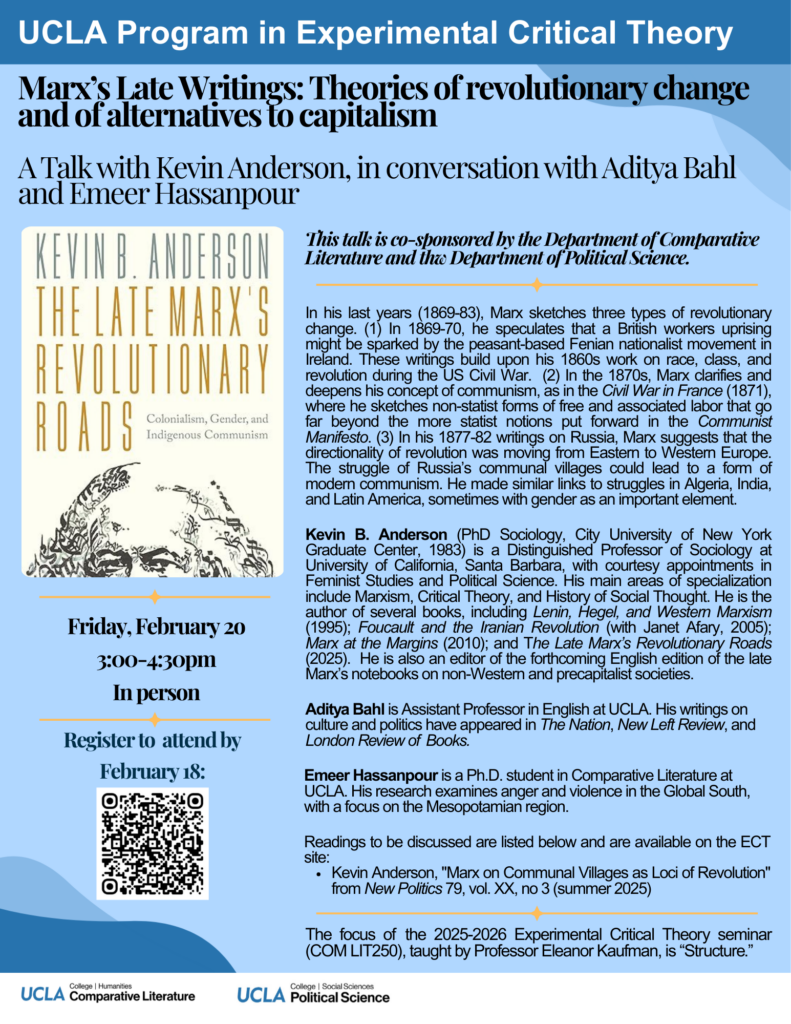
Marx’s Late Writings: Theories of revolutionary change and of alternatives to Capitalism
In his last years (1869-83), Marx sketches three types of revolutionary change. (1) In 1869-70, he speculates that a British workers uprising might be sparked by the peasant-based Fenian nationalist movement in Ireland. These writings build upon his 1860s work on race, class, and revolution during the US Civil War. (2) In the 1870s, Marx clarifies and deepens his concept of communism, as in the Civil War in France (1871), where he sketches non-statist forms of free and associated labor that go far beyond the more statist notions put forward in the Communist Manifesto. (3) In his 1877-82 writings on Russia, Marx suggests that the directionality of revolution was moving from Eastern to Western Europe. The struggle of Russia’s communal villages could lead to a form of modern communism. He made similar links to struggles in Algeria, India, and Latin America, sometimes with gender as an important element.
Readings to be discussed are linked below:
3/2/25 A Talk with Justin Clemens
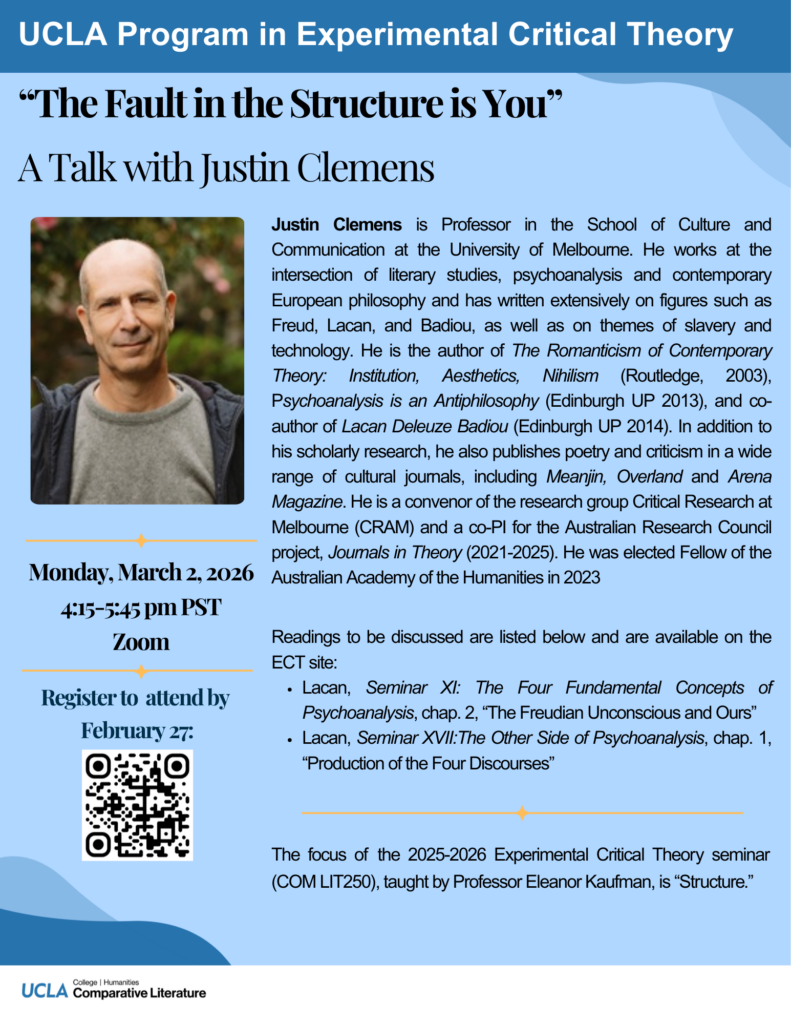
REGISTER TO ATTEND VIA ZOOM HERE
Justin Clemens is Professor in the School of Culture and Communication at the University of Melbourne. He works at the intersection of literary studies, psychoanalysis and contemporary European philosophy and has written extensively on figures such as Freud, Lacan, and Badiou, as well as on themes of slavery and technology. He is the author of The Romanticism of Contemporary Theory: Institution, Aesthetics, Nihilism (Routledge, 2003), Psychoanalysis is an Antiphilosophy (Edinburgh UP 2013), and co-author of Lacan Deleuze Badiou (Edinburgh UP 2014). In addition to his scholarly research, he also publishes poetry and criticism in a wide range of cultural journals, including Meanjin, Overland and Arena Magazine. He is a convenor of the research group Critical Research at Melbourne (CRAM) and a co-PI for the Australian Research Council project, Journals in Theory (2021-2025). He was elected Fellow of the Australian Academy of the Humanities in 2023.
Readings are linked below:
3/4/26 A Talk with Robin James
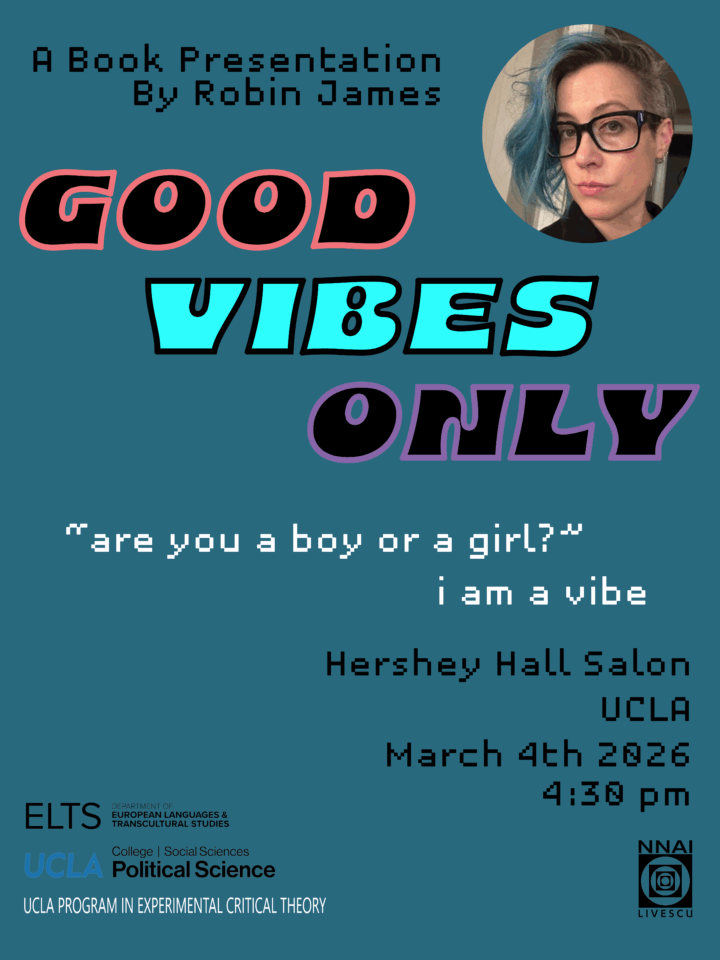
Good Vibes Only | A Book Presentation by Robin James
The UCLA Livescu Initiative on Neuro, Narrative, and AI (NNAI) is partnering with the Program in Experimental Critical Theory, the Department of Political Science, and the Department of European Languages and Transcultural Studies, to host a talk by renowned independent scholar and editor Dr. Robin James about her upcoming book, “Good Vibes Only“.
A follow-up to The Sonic Episteme, this book attends to the relationship between biopower’s quantitative and qualitative dimensions. My previous book demonstrated the ways sound, as a frequency, was used to translate statistical normalization, or the measurement of the most frequent frequencies in a population, into qualitative terms. This book argues that phenomenological orientation or horizon has a similar function in contexts such as recommender algorithms and the density models used in contemporary AI and Machine Learning where probability is modeled as something other than a normalized distribution. Phenomenology is uniquely well-suited to theorize these models that as Amoore, Cooper, Joque, and others have argued, blend hard math with subjective intuition, as (per philosophers like Shiloh Whitney), phenomenology, unlike affect theory, rejects the strict separation between what we can very loosely call “mind” and “body” (cognitive content and felt sense).
These mathematical models have been vernacularized as “vibes”, which are qualitative categories that everyone from 2020s social media users to music streaming services use to define the same sorts of orientations or tendencies that vectors model mathematically. “Vibes” are a lay term for more or less the same phenomenon philosophers call phenomenological orientations or horizons. Studying late 2010s and early 2020s internet culture and American popular music from the 1970s through today, the book shows how orientations are policed not for their normativity, but for their lineage – or rather, their capacity to carry forward the patriarchal racial capitalist distribution of wealth and personhood into presently-counterfactual realities. Then, in the final chapter, I argue that although my theory and critique of the biopolitics of algorithmic legitimation is grounded in 21st century Anglophone feminist of color phenomenology, the fact of orientation not inherently or necessarily critical of patriarchal racial capitalist power relations—Heidegger’s whole project is oriented towards what he calls “spiritual National Socialism.” In order to orient ourselves otherwise, what matters is to whom we collectively choose to orient ourselves toward, and from whom we orient ourselves away. In this respect, Beauvoir’s existential phenomenology, which frames (re)orientation or (re) “situation” as a matter of choosing some people and some values over (and against) others, is a helpful theoretical model for imagining how we might do phenomenology otherwise.
4/14/26 A Talk with Irving Goh
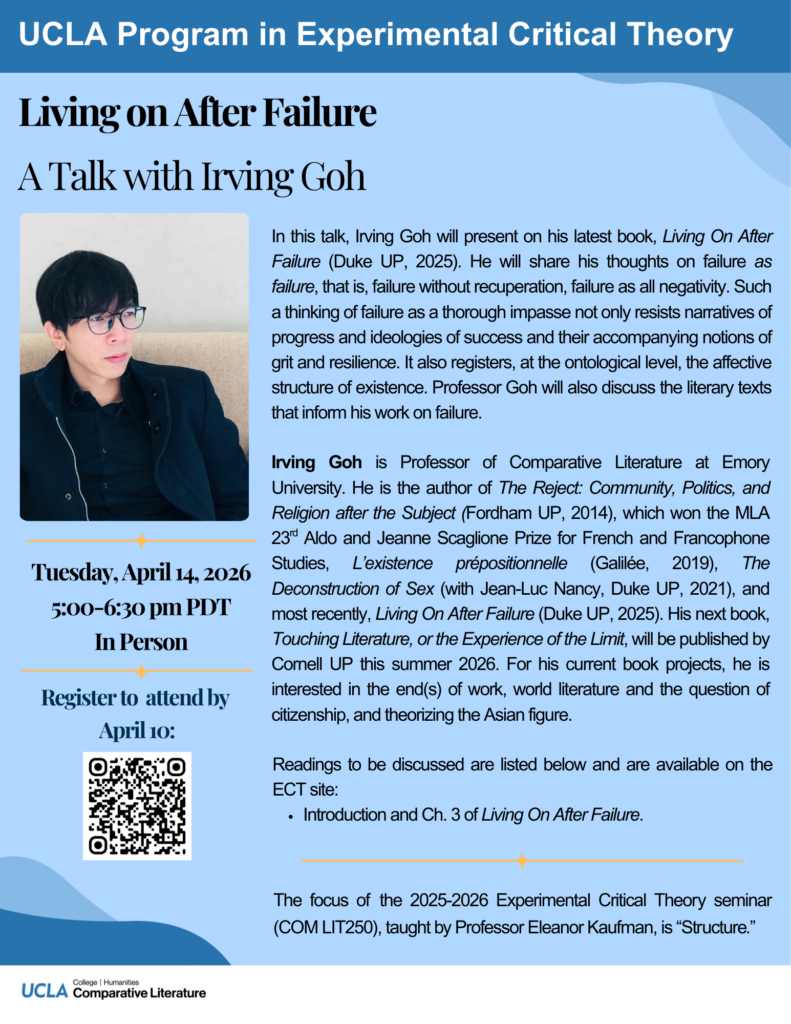
In this talk, Irving Goh will present on his latest book, Living On After Failure (Duke UP, 2025). He will share his thoughts on failure as failure, that is, failure without recuperation, failure as all negativity. Such a thinking of failure as a thorough impasse not only resists narratives of progress and ideologies of success and their accompanying notions of grit and resilience. It also registers, at the ontological level, the affective structure of existence. Professor Goh will also discuss the literary texts that inform his work on failure.
Readings are available below:
4/30/26 A Talk with Kate Manne
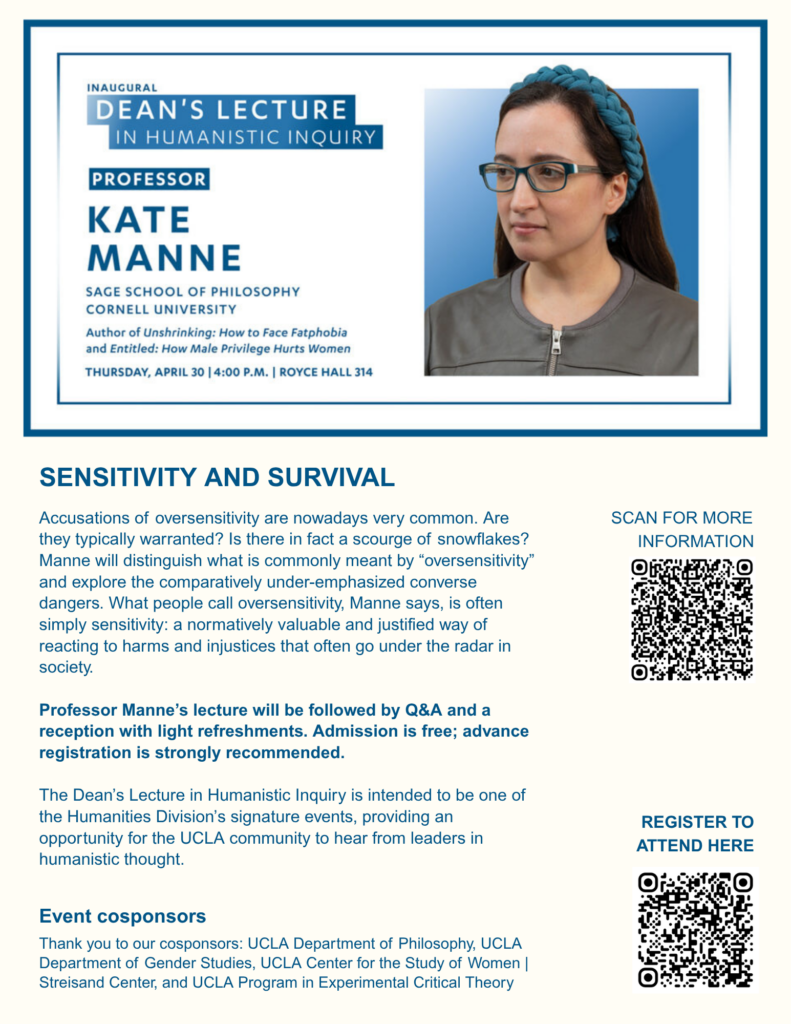
The Inaugural Dean’s Lecture in Humanistic Inquiry
Thursday, April 30
4 p.m. – 6 p.m.
Royce Hall Room 314
Free admission. Reception with light refreshments to follow lecture. Advance registration strongly recommended.
Presented by the UCLA College Division of Humanities
The Dean’s Lecture in Humanistic Inquiry is a biennial lecture dedicated to exploring cross-cutting topics and ideas in humanistic research and examining how humanistic inquiry connects to the most pressing questions of the day.
About our inaugural speaker
Kate Manne is a professor at the Sage School of Philosophy at Cornell University. She specializes in moral, social and feminist philosophy, and has written three books: DOWN GIRL: The Logic of Misogyny (Oxford University Press, 2018), ENTITLED: How Male Privilege Hurts Women (Crown, 2020) and UNSHRINKING: How to Face Fatphobia (Crown, 2024). In addition to her academic work, she regularly writes opinion pieces and essays for a wider audience, including in outlets such as The New York Times, The Cut, The Washington Post, The Atlantic, The Nation and Time. She writes a Substack newsletter, More to Hate, exploring misogyny, fatphobia and their intersection.
About Professor Manne’s lecture
Sensitivity and Survival
Accusations of oversensitivity are nowadays very common. Are they typically warranted? Is there in fact a scourge of snowflakes?
In this lecture, Kate Manne will distinguish three things that are commonly meant by “oversensitivity”: over-identification of instances, over-extension of the relevant concepts and over-reactions to the relevant harms or forms of injustice, such as sexism, misogyny and racism. Her talk will draw on two rich humanistic traditions: feminist epistemology and non-ideal theory.
While acknowledging that oversensitivity of all three kinds can and does occur, Manne will highlight and explore the comparatively under-emphasized converse dangers: the under-identification of instances, the under-extension of concepts, and under-reactions or the undermining of warranted reactions, respectively. In view of this, she concludes that what is called oversensitivity is often simply sensitivity: a normatively valuable and justified way of reacting to harms and injustices that often go under the radar in society as we know it.
Please visit this page to register.
Event cosponsors
Thank you to our cosponsors: UCLA Department of Philosophy, UCLA Department of Gender Studies, UCLA Center for the Study of Women | Streisand Center, and UCLA Program in Experimental Critical Theory
5/15/26 Jameson in California – and Beyond
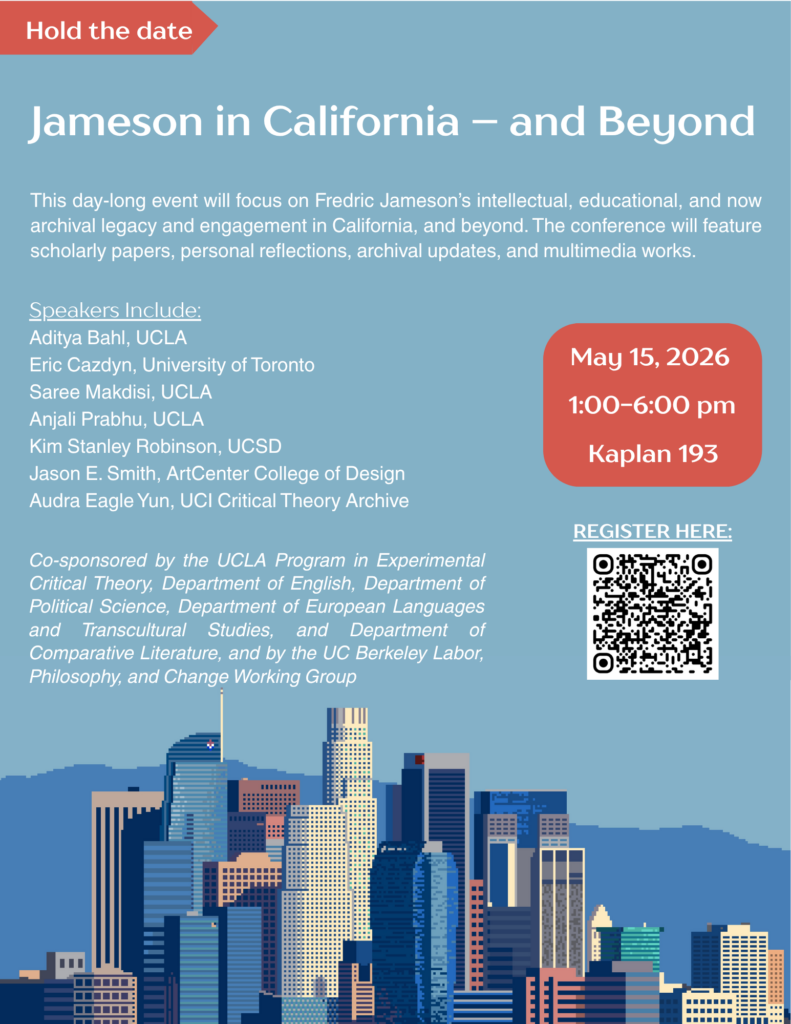
Please hold the date for the upcoming conference Jameson in California – and Beyond, which will take place on May 15, 2026. The event will run from 1:00-6:00pm in Kaplan 193. Additional information will be forthcoming.
Advance Registration is required for catering purposes.
5/22/26 Banu Bargu Roundtable
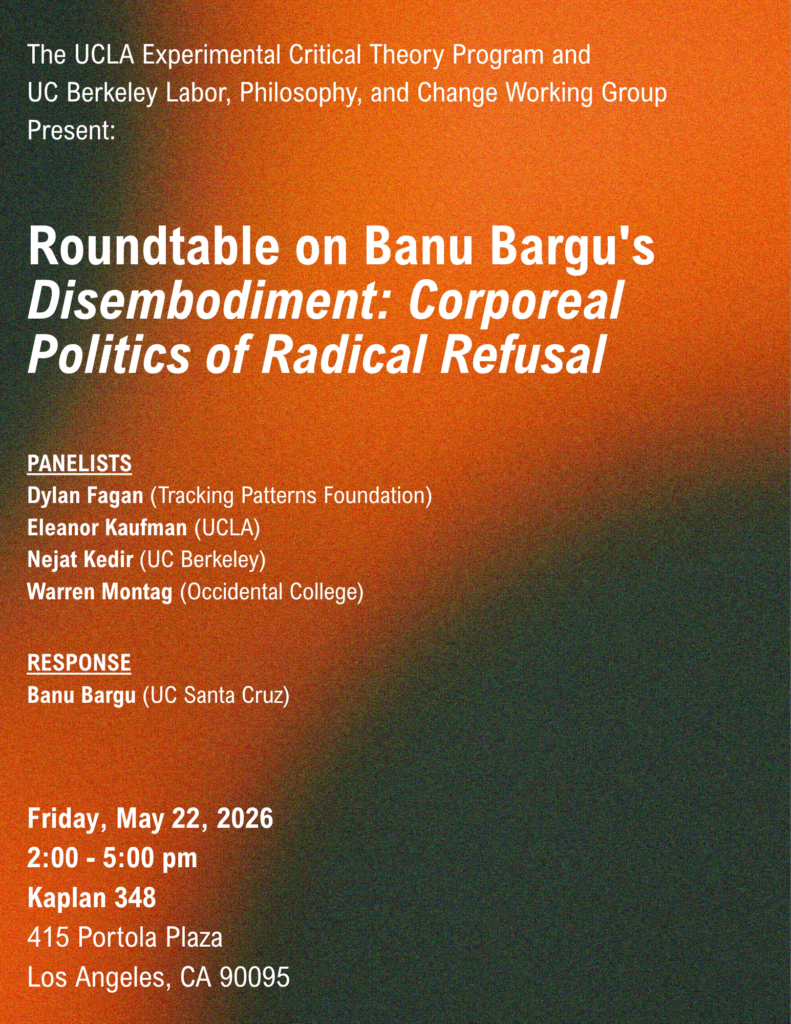
Roundtable on Banu Bargu’s Disembodiment: Corporeal Politics of Radical Refusal
Friday, May 22, 2026
2:00 – 5:00 p.m.
Kaplan Hall Room #348
415 Portola Plaza
Los Angeles, CA 90095
Presented by The UCLA Experimental Critical Theory Program and UC Berkeley Labor, Philosophy, and Change Working Group.
PANELISTS
- Dylan Fagan (Tracking Patterns Foundation)
- Eleanor Kaufman (UCLA)
- Nejat Kedir (UC Berkeley)
- Warren Montag (Occidental College)
RESPONSE
- Banu Bargu (UC Santa Cruz)